
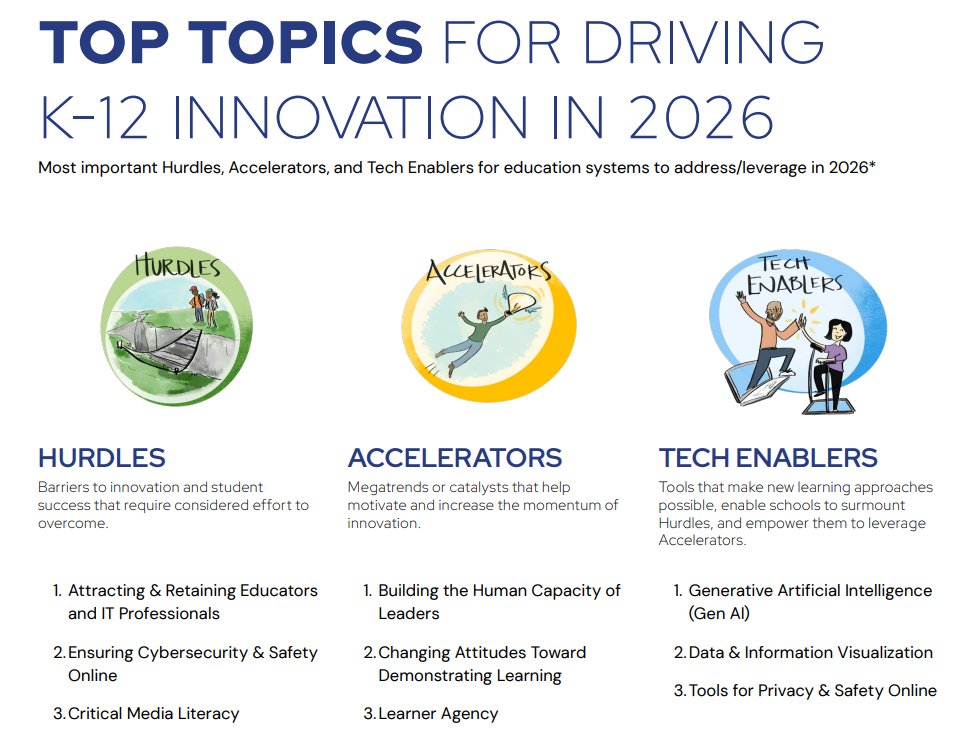
Each year, CoSN’s Driving K–12 Innovation Report gives school leaders a structured way to think about change. This year I joined many EdTech leaders across the world to shape the report. It was a pleasure to meet with these leaders and discuss what is going on in our area. The 2026 report keeps its familiar format of Hurdles, Accelerators, and Tech Enablers. What feels stronger this year is the steady emphasis on trust, leadership, and responsible use of AI.
Below are my notes of the 9 key points.
Hurdles
Attracting and retaining educators and IT professionals
Staffing remains a steady concern. Districts continue to face competition, workload strain, and burnout. The report also notes that workplace culture, leadership support, and professional growth opportunities influence whether people stay.
Cybersecurity and online safety
Security is now part of daily operations. As schools rely on digital systems for instruction and management, the risks increase. The report emphasizes shared responsibility across staff and the need for ongoing awareness.
Critical media literacy
New to the hurdles list this year, media literacy reflects the rise of AI-generated content and misinformation. Students must sort through complex digital information. Schools play a central role in helping them evaluate sources and think critically.
Accelerators
Building the human capacity of leaders
Innovation depends on leadership. The report stresses that school leaders need a working understanding of AI, data, and digital systems. Informed leadership supports stronger decision-making.
Changing attitudes toward demonstrating learning
Districts are rethinking how students show what they know. Portfolios, project-based learning, and performance tasks are gaining attention. These approaches aim to reflect deeper understanding, not just test performance.
Learner agency
Student voice and choice continue to shape conversations about instruction. Agency requires flexibility in structure and mindset. The report describes it as both a cultural and operational shift.
Tech Enablers
Generative AI
AI tools are now part of the K–12 landscape. The report describes them as a turning point. Schools are exploring how AI can support planning, communication, and differentiation while also setting boundaries for responsible use.
Data and information visualization
Clear dashboards and data displays help educators see patterns more quickly. The report notes that strong data practices are essential for these tools to be effective.
Privacy and safety tools
Digital trust remains central. Privacy protections and safety systems are described as foundational to school technology programs. Transparency and governance shape how these tools are implemented.